Two youth programs will be held in conjunction with this year's research project: 4-H Small Ruminant Research Academy and 4-H Entrepreneurship Program.
Interested youth should contact Ashley Travis for more information and to apply. Ashley can be reached at ashley90@umd.edu or (301) 791-1304.
Wednesday, January 2, 2019
Monday, October 8, 2018
Final Results: Growth & Carcass
Data from the 2018 comparison study of ram, wether, and short-scrotum lambs were statistically analyzed by Dr. Dahlia O'Brien at Virginia State University.
The short-scrotum rams had heavier final weights than the wether lambs: 117.7 ± 2.0 vs. 110.4 ± 1.7 lbs. Ram lambs were intermediate: 113.4 ± 2.0 lbs. Short scrotum lambs had greater average daily gain (ADG) than wether lambs: 0.549 ± 0.02 lb/d vs. 0.482 ± 0.02 lb/d. Ram lambs were intermediate: 0.510 ± 0.02 lb/d.
There was a tendency for sex to influence rib eye area (REA), as determined by ultrasound. Wether lambs tended to have smaller REA compared to ram and short-scrotum lambs. However, when REA was adjusted to a common weight (100 lbs.), there was no difference between the sexes. Sex did not influence other ultrasonic measurements: backfat (BF) and loin depth.
Actual carcass measurements showed wethers to be fatter, having greater BF (0.15 ± 0.01 in.), thus yield grade (1.9 ± 0.1). Ram lambs produced the leanest carcasses (0.11 ± 0.01 in. and 1.5 ± 0.1, respectively). The short-scrotum lambs were intermediate (0.12 ± 0.01 in. and 1.6 ± 0.1, respectively). There was a tendency for sex to influence hot carcass weight (HCW), with short-scrotum lambs tending to have the heaviest HCW.
Sex did not affect dressing percentage (49.2 ± 0.3 percent), body wall thickness (0.60 ± 0.2 in.) REA (3.0 ± 0.1 sq. in.), REA adjusted to 100 lbs. (2.7 ± 0.04 sq.in.), percent kidney and heart fat (KH; 1.9 ± 0.1 percent), leg conformation score (12.2 ± 0.1), or percent boneless closely trimmed retail cuts (BCTRC; 49.9 ± 0.1 percent).
Conclusion
Compared to wether lambs, short-scrotum lambs showed superior growth and produced leaner carcasses. The short-scrotum procedure may offer a viable alternative to traditional castration.
Ultrasound vs. actual carcass measurements
Actual BF measurements were highly correlated with ultrasound BF measurements (r=0.7). REA measurements were also highly correlated (r=0.7) in wether and ram lambs. However, there was not a high correlation in REA measurements in the short scrotum lambs (r=0.4). Correlation coefficients (r values) vary from -1 to 1. The closer r is to -1 or 1, the more closely the variables are related.Closer to 0, the opposite is true.
The short-scrotum rams had heavier final weights than the wether lambs: 117.7 ± 2.0 vs. 110.4 ± 1.7 lbs. Ram lambs were intermediate: 113.4 ± 2.0 lbs. Short scrotum lambs had greater average daily gain (ADG) than wether lambs: 0.549 ± 0.02 lb/d vs. 0.482 ± 0.02 lb/d. Ram lambs were intermediate: 0.510 ± 0.02 lb/d.
Actual carcass measurements showed wethers to be fatter, having greater BF (0.15 ± 0.01 in.), thus yield grade (1.9 ± 0.1). Ram lambs produced the leanest carcasses (0.11 ± 0.01 in. and 1.5 ± 0.1, respectively). The short-scrotum lambs were intermediate (0.12 ± 0.01 in. and 1.6 ± 0.1, respectively). There was a tendency for sex to influence hot carcass weight (HCW), with short-scrotum lambs tending to have the heaviest HCW.
Sex did not affect dressing percentage (49.2 ± 0.3 percent), body wall thickness (0.60 ± 0.2 in.) REA (3.0 ± 0.1 sq. in.), REA adjusted to 100 lbs. (2.7 ± 0.04 sq.in.), percent kidney and heart fat (KH; 1.9 ± 0.1 percent), leg conformation score (12.2 ± 0.1), or percent boneless closely trimmed retail cuts (BCTRC; 49.9 ± 0.1 percent).
Conclusion
Compared to wether lambs, short-scrotum lambs showed superior growth and produced leaner carcasses. The short-scrotum procedure may offer a viable alternative to traditional castration.
Ultrasound vs. actual carcass measurements
Actual BF measurements were highly correlated with ultrasound BF measurements (r=0.7). REA measurements were also highly correlated (r=0.7) in wether and ram lambs. However, there was not a high correlation in REA measurements in the short scrotum lambs (r=0.4). Correlation coefficients (r values) vary from -1 to 1. The closer r is to -1 or 1, the more closely the variables are related.Closer to 0, the opposite is true.
Friday, September 28, 2018
Research Project Provides Lamb for Campus
The University of Maryland dining halls featured local food at its September 26 Harvest Festival. One of the local foods featured was the lamb from our research project. Campus dining services purchased all sixty lambs from our research project.
The lambs from the project were provided by Shepherds Manor Creamery in Westminster. Shepherds Manor Creamery is operated by Mike & Colleen Histon. It is Maryland's first and only licensed sheep dairy. The lambs used in the research project were a cross between the East Friesian and Lacaune breeds. They averaged 113 pounds at the time of harvest. They were finished on a combination of pasture and grain.
The Harvest Festival featured "Braised Leg of Lamb." It was delicious. Lamb will be featured again in the spring. Dining services has indicated a desire to purchase the lambs from next year's project.
| One of the university's chefs |
The lambs from the project were provided by Shepherds Manor Creamery in Westminster. Shepherds Manor Creamery is operated by Mike & Colleen Histon. It is Maryland's first and only licensed sheep dairy. The lambs used in the research project were a cross between the East Friesian and Lacaune breeds. They averaged 113 pounds at the time of harvest. They were finished on a combination of pasture and grain.
The Harvest Festival featured "Braised Leg of Lamb." It was delicious. Lamb will be featured again in the spring. Dining services has indicated a desire to purchase the lambs from next year's project.
Saturday, September 22, 2018
Getting Ready for Next Year
We're already making plans for next year's research project. The project will be similar. We will be comparing ram, wether, and short-scrotum lambs. It is important to replicate this year's project to see if we get similar results.
The farm that provided this year's lambs has agreed to provide lambs for next year's project. This is great news. This year's lambs were very healthy, despite all the rain, and produced good quality carcasses. They were docile and easy to handle.
The lambs grazed mostly annuals this year: spring oats and dwarf pearl millet. We are establishing perennial pastures, leaving two acres for annual forages. A cover crop was planted into these two acres. The perennial pasture mixes include a variety of cool season grasses (orchardgrass, fescue ryegrass, and bromegrass), clovers (red and white), and herbs (chicory).
The pasture system consists of 10 acres. It will be divided into five, 2-acre paddocks for rotational grazing. There is an additional ~2.5 acres of silvopasture that contains mostly cool season grasses (fescue). The lambs always have access to a central laneway that contains shelter (40 ft. x 40 ft. roofed structure), water troughs, feeders, and the handling system.
![]() |
| Fall planting of cool season pasture mix |
The farm that provided this year's lambs has agreed to provide lambs for next year's project. This is great news. This year's lambs were very healthy, despite all the rain, and produced good quality carcasses. They were docile and easy to handle.
The lambs grazed mostly annuals this year: spring oats and dwarf pearl millet. We are establishing perennial pastures, leaving two acres for annual forages. A cover crop was planted into these two acres. The perennial pasture mixes include a variety of cool season grasses (orchardgrass, fescue ryegrass, and bromegrass), clovers (red and white), and herbs (chicory).
The pasture system consists of 10 acres. It will be divided into five, 2-acre paddocks for rotational grazing. There is an additional ~2.5 acres of silvopasture that contains mostly cool season grasses (fescue). The lambs always have access to a central laneway that contains shelter (40 ft. x 40 ft. roofed structure), water troughs, feeders, and the handling system.
Tuesday, September 4, 2018
Carcass Measurements
After determining ending weights (LW) on August 13, the lambs (n=60) were transported to Hamzah Slaughterhouse (in Williamsport, Maryland) for immediate slaughter. The slaughterhouse was 9.5 miles away.
Carcass data was obtained from 51 lambs: 16 ram lambs, 15 short-scrotum lambs, and 20 wethers. Hot carcass weights (HCW) were determined immediately after slaughter. After overnight chilling, the carcasses were evaluated. The carcasses were split between the 12 and 13th ribs to expose the rib eye. A plastic grid was used to measure the area of the rib eye muscle (REA; 20 dots=1 in²). A metal ruler was used measure to backfat thickness (BF) and thickness of the body wall (BWT). Kidney and heart fat (KH) and leg conformation scores (LC) were subjectively evaluated.
Dressing percentage (DP) was determined using the following formula HCW ÷ LW. A few cold carcass weights were obtained. Shrinkage was less than 1 percent. REA was converted to an equivalent weight basis (100 pounds; CWT) using the following formula: (REA ÷ LW) x 100. Yield grade (YG) was calculated using the following formula: (back fat x 10) + 0.4. Percent boneless, close trimmed retail cuts (BCTRC) was calculated using the following formula: 49.936 - (0.0848 x HCW) - (4.376 x BF) - (3.530 x BW) + (2.456 x REA)*.
It is not known if any of the differences are statistically significant.
HCW ranged from 37.0 to 72.0 pounds and averaged 55.4 ± 7.5 lbs. The short-scrotum lambs had the heaviest HCW: 57.3 ± 5.3 lbs. HCW of the ram lambs (56.3 ± 8.8 lbs) was more than the wether lambs (53.4 ± 7.6 lbs). DP ranged from 44.9 to 53.3 and averaged 49.2 ± 1.9 percent. The median DP was 49.2 percent. The wethers had slighter higher DP (49.6 ± 2%) than the short-scrotum (49.1 ± 1.7%) and ram lambs (48.7 ± 1.9%).
BF ranged from 0.5 to 0.25 inches and averaged 0.128 ± 0.05 inches. The median BF was 0.10 inches. The wether lambs had the most backfat (0.145 ± .056 in) . The short-scrotum lambs had the least (0.113 ± 0.035 in). The ram lambs were intermediate (0.122 ± 0.045 in). BWT ranged from 0.30 to 0.80 and averaged 0.635 ± 0.144 inches. The median BWT was 0.60 inches. The ram lambs had the lowest BWT: 0.619 ± 0.167 inches. Short-scrotum and wether lambs were similar.
REA ranged from 2.25 to 3.85 in² and averaged 3.04 ± 0.45 in². The median REA was 3.10 in². The short-scrotum lambs had the largest REA: 3.19 ± 0.45 in². The wethers had the smallest REA: 2.91 ± 0.48 in². The ram lambs were intermediate: 3.06 ± 0.44 in². REA per 100 lbs. (CWT) ranged from 2.00 to 3.41 in² and averaged 2.70 ± 0.29 in². The median was 2.64 in². CWT was lowest for the ram lambs (2.66 ± 0.20 in²) and similar for the short-scrotum (2.74 ± 0.32 in²) and wether lambs (2.71 ± 0.32 in²).
KH ranged from 1 to 3 and averaged 1.85 ± 0.65 percent. The median KH was 2.0 The three groups of lambs had similar KH. LC ranged from 10 (low Choice) to 14 (average Prime) and averaged 12.2 ± 0.9. The median LC was 12 (Choice plus). YG ranged from 0.9 to 2.4 and averaged 1.68 ± 0.48. The median YG was 1.40, The short-scrotum lambs had the lowest YG: 1.53 ± 0.35. The wether lambs had the highest YG: 1.85 ± 0.56. The ram lambs were intermediate: 1.62 ± 0.45.
Thirty lambs (58.8%) were yield grade 1. Only 21 (41.1%) of the lambs were yield grade 2 or 3. Yield grade 1 lambs may be suitable for some ethnic markets, but they are generally considered to be too thin (not finished). They typically sell for lower prices than yield grade 2 or 3 lambs, unless they are sold as feeder lambs for further feeding/finishing. Four lambs (two rams and two wethers) had less than 0.8 inches of back fat; thus, failing to qualify for the USDA Choice grade. All other lambs graded USDA Choice or higher.
Percent BCTRC ranged from 46.9 to 52.8 percent and averaged 49.9 ± 0.84 percent. There were numerical differences between the three groups, but they are not likely statistically significant.
Compared to ultrasound data
While the carcass measurements showed the lambs to have more BF and larger REA, the comparisons between the three groups of lambs were similar, regardless of data source.
*Source: Scott Greiner, Lamb Carcass Evaluation, Virginia Tech
Carcass data was obtained from 51 lambs: 16 ram lambs, 15 short-scrotum lambs, and 20 wethers. Hot carcass weights (HCW) were determined immediately after slaughter. After overnight chilling, the carcasses were evaluated. The carcasses were split between the 12 and 13th ribs to expose the rib eye. A plastic grid was used to measure the area of the rib eye muscle (REA; 20 dots=1 in²). A metal ruler was used measure to backfat thickness (BF) and thickness of the body wall (BWT). Kidney and heart fat (KH) and leg conformation scores (LC) were subjectively evaluated.
Dressing percentage (DP) was determined using the following formula HCW ÷ LW. A few cold carcass weights were obtained. Shrinkage was less than 1 percent. REA was converted to an equivalent weight basis (100 pounds; CWT) using the following formula: (REA ÷ LW) x 100. Yield grade (YG) was calculated using the following formula: (back fat x 10) + 0.4. Percent boneless, close trimmed retail cuts (BCTRC) was calculated using the following formula: 49.936 - (0.0848 x HCW) - (4.376 x BF) - (3.530 x BW) + (2.456 x REA)*.
| Group | No. | LW | HCW | DP | BF | BWT | REA | CWT | KH | LC | YG | BCTRC |
|---|---|---|---|---|---|---|---|---|---|---|---|---|
| Ram | 16 | 117.5 | 56.3 | 48.7 | 0.122 | 0.619 | 3.06 | 2.66 | 1.84 | 12.4 | 1.62 | 50.0 |
| Short-scrotum | 15 | 116.5 | 57.3 | 49.1 | 0.113 | 0.647 | 3.19 | 2.74 | 1.79 | 12.1 | 1.53 | 50.1 |
| Wether | 20 | 104.4 | 53.4 | 49.6 | 0.145 | 0.640 | 2.91 | 2.71 | 1.85 | 12.1 | 1.85 | 49.7 |
| ALL | 51 | 113.3 | 55.4 | 49.2 | 0.128 | 0.636 | 3.04 | 2.70 | 1.85 | 12.2 | 1.68 | 49.9 |
HCW ranged from 37.0 to 72.0 pounds and averaged 55.4 ± 7.5 lbs. The short-scrotum lambs had the heaviest HCW: 57.3 ± 5.3 lbs. HCW of the ram lambs (56.3 ± 8.8 lbs) was more than the wether lambs (53.4 ± 7.6 lbs). DP ranged from 44.9 to 53.3 and averaged 49.2 ± 1.9 percent. The median DP was 49.2 percent. The wethers had slighter higher DP (49.6 ± 2%) than the short-scrotum (49.1 ± 1.7%) and ram lambs (48.7 ± 1.9%).
![]() |
| Jeff Semler |
REA ranged from 2.25 to 3.85 in² and averaged 3.04 ± 0.45 in². The median REA was 3.10 in². The short-scrotum lambs had the largest REA: 3.19 ± 0.45 in². The wethers had the smallest REA: 2.91 ± 0.48 in². The ram lambs were intermediate: 3.06 ± 0.44 in². REA per 100 lbs. (CWT) ranged from 2.00 to 3.41 in² and averaged 2.70 ± 0.29 in². The median was 2.64 in². CWT was lowest for the ram lambs (2.66 ± 0.20 in²) and similar for the short-scrotum (2.74 ± 0.32 in²) and wether lambs (2.71 ± 0.32 in²).
KH ranged from 1 to 3 and averaged 1.85 ± 0.65 percent. The median KH was 2.0 The three groups of lambs had similar KH. LC ranged from 10 (low Choice) to 14 (average Prime) and averaged 12.2 ± 0.9. The median LC was 12 (Choice plus). YG ranged from 0.9 to 2.4 and averaged 1.68 ± 0.48. The median YG was 1.40, The short-scrotum lambs had the lowest YG: 1.53 ± 0.35. The wether lambs had the highest YG: 1.85 ± 0.56. The ram lambs were intermediate: 1.62 ± 0.45.
| Group | No. | YG 1 | YG 2 | YG3 | ≥ Choice | < Choice |
|---|---|---|---|---|---|---|
| Ram | 16 | 11 | 5 | 0 | 14 | 2 |
| Short-scrotum | 15 | 11 | 4 | 0 | 15 | 0 |
| Wether | 20 | 8 | 11 | 1 | 18 | 2 |
| ALL | 51 | 30 | 20 | 1 | 47 | 4 |
Thirty lambs (58.8%) were yield grade 1. Only 21 (41.1%) of the lambs were yield grade 2 or 3. Yield grade 1 lambs may be suitable for some ethnic markets, but they are generally considered to be too thin (not finished). They typically sell for lower prices than yield grade 2 or 3 lambs, unless they are sold as feeder lambs for further feeding/finishing. Four lambs (two rams and two wethers) had less than 0.8 inches of back fat; thus, failing to qualify for the USDA Choice grade. All other lambs graded USDA Choice or higher.
Percent BCTRC ranged from 46.9 to 52.8 percent and averaged 49.9 ± 0.84 percent. There were numerical differences between the three groups, but they are not likely statistically significant.
Compared to ultrasound data
While the carcass measurements showed the lambs to have more BF and larger REA, the comparisons between the three groups of lambs were similar, regardless of data source.
| Group | No. | BF-scan | BF-carcass | REA-scan | REA-carcass |
|---|---|---|---|---|---|
| Ram | 16 | 0.860 | 0.122 | 1.81 | 3.06 |
| Short-scrotum | 15 | 0.900 | 0.113 | 1.86 | 3.19 |
| Wether | 19 | 0.104 | 0.142 | 1.69 | 2.87 |
| ALL | 50 | 0.940 | 0.127 | 1.78 | 3.03 |
*Source: Scott Greiner, Lamb Carcass Evaluation, Virginia Tech
Monday, August 27, 2018
Ultrasound Results: Unanalyzed Data
The lambs were scanned on August 6 to determine carcass characteristics.The short-scrotum lambs (n=17) scanned with slightly larger rib eye areas (1.88 in2) than the ram (n=19) or wether (n=23) lambs (1.85 and 1.70 in2, respectively) but when rib eye area was adjusted to a common weight (100 lbs), they had slightly smaller rib eye areas (1.54 in2), and there were no differences between the ram and wether lambs (1.58 in2). The ram and short-scrotum lambs had deeper loins compared to the wether lambs (0.99 vs. 0.93 inches).
For the 59 lambs scanned, the average rib eye measurement was 1.8 in2 or 1.59 in2 per 100-lb. live weight. It is worth noting that the actual carcass measurements were considerably higher. For the 51 carcasses measured, the average rib eye measurement was 3.04 in2 or 2.70 in2 100-lb. live weight.
It is not yet known if any of the differences are statistically significant.
According to scanning, the wether lambs had a little more backfat (0.102 inches) than the ram and short-scrotum lambs (0.086 and 0.088 inches, respectively). Average backfat for the 59 lambs scanned was 0.09 inches, compared to 0.128 for the actual carcass measurements (n=51). All carcass measurements (ultrasound and actual) were taken between the 12th and 13th ribs. Rib eye was measured on the carcass using a plastic grid (Iowa State University), where 20 dots are equal to 1 in2.
The moderate level of nutrition (pasture, plus some grain) provided did not result in the majority of lambs reaching market readiness. Lambs with less than 0.8 inches of backfat fail to qualify for the USDA Choice grade. The yield grade of a lamb with 0.9 inches of backfat is only 1.3 Yield grade 1 lambs are considered too thin and generally do not receive the price premiums than yield grade 2 and 3 lambs receive.
For the 59 lambs scanned, the average rib eye measurement was 1.8 in2 or 1.59 in2 per 100-lb. live weight. It is worth noting that the actual carcass measurements were considerably higher. For the 51 carcasses measured, the average rib eye measurement was 3.04 in2 or 2.70 in2 100-lb. live weight.
| Group | No. | Live Wt., lbs. | REA, in2 | REA per cwt | Loin depth, in. | Backfat, in. |
|---|---|---|---|---|---|---|
| Ram | 19 | 117.5 | 1.85 | 1.58 | 0.99 | 0.086 |
| Short-scrotum | 17 | 116.5 | 1.88 | 1.54 | 0.99 | 0.088 |
| Wether | 23 | 104.4 | 1.70 | 1.58 | 0.93 | 0.102 |
| ALL | 59 | 113.3 | 1.80 | 1.59 | 1.00 | 0.090 |
According to scanning, the wether lambs had a little more backfat (0.102 inches) than the ram and short-scrotum lambs (0.086 and 0.088 inches, respectively). Average backfat for the 59 lambs scanned was 0.09 inches, compared to 0.128 for the actual carcass measurements (n=51). All carcass measurements (ultrasound and actual) were taken between the 12th and 13th ribs. Rib eye was measured on the carcass using a plastic grid (Iowa State University), where 20 dots are equal to 1 in2.
The moderate level of nutrition (pasture, plus some grain) provided did not result in the majority of lambs reaching market readiness. Lambs with less than 0.8 inches of backfat fail to qualify for the USDA Choice grade. The yield grade of a lamb with 0.9 inches of backfat is only 1.3 Yield grade 1 lambs are considered too thin and generally do not receive the price premiums than yield grade 2 and 3 lambs receive.
Tuesday, August 21, 2018
Fertility: Preliminary Results
The fertility of ram (n=17), wether (n=24), and short-scrotum (n=17) lambs was evaluated. Blood samples were collected from each lamb to measure testosterone levels.
Libido was evaluated using a pen test. Each lamb (n=60) was placed in a 8 ft. x 8 ft. pen with two estrus ewes. The ewes had been treated with CIDR inserts so that they were in estrus (heat) on the day of testing (August 9). There were two pens of two ewes. Lambs were randomly assigned to a pen (A or B).
Each lamb was in the pen with ewes for five minutes. Breeding behaviors were observed and recorded. Behaviors observed included sniffing, butting, kicking, lip curling (flehman's response), mounting, servicing (ejaculating), and time to service.
The short-scrotum lambs displayed similar breeding behavior as the ram lambs, though the ram lambs had twice as many services and a shorter time to service (table 1).
Table 1. Libido
Numbers with different superscripts are statistically different.
Semen was collected from six rams and six short-scrotum lambs. An estrus ewe was used for collection. The semen was collected using an artificial vagina (AV). The semen samples were evaluated on site, then later in a lab by Dr. Dahlia O'Brien from Virginia State University.
Ejaculates of short scrotum lambs were essentially devoid of sperm
and could not be tested with standard procedures. Ejaculates of the
intact rams had a concentration of 1.2 billion sperm/ml, 87% motility,
and 82% viability. Ejaculate characteristics
of short scrotum males would have rendered them sterile.
Click to view video of ejaculate from intact ram lamb
Click to view video of ejaculate from short-scrotum lamb
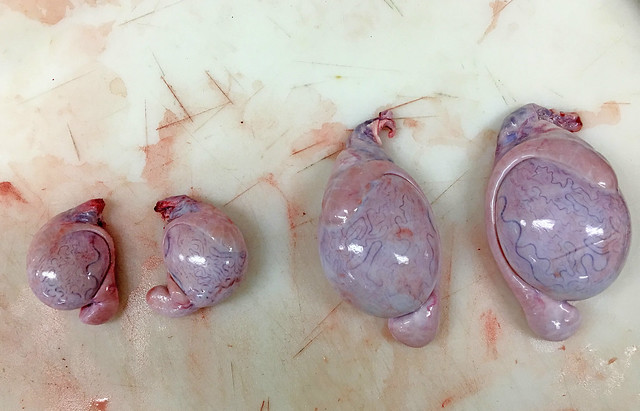
Testicles were collected at the time of slaughter, five pairs each from rams and short-scrotum lambs. The testes were dissected and weighed by Dr. Stephan Wildeus at Virginia State University. The short-scrotum lambs had significantly smaller testes than the ram lambs: 114.5 g vs. 393 g. The testicles from the short-scrotum rams also had a different consistency. The epididmymal weight was also smaller (21 vs. 50 g) in the short-scrotum lambs, as were the ratios of parenchyma: tunica and testis: epididmymis (table 2)
Table 2. Organ weights
Numbers with different superscripts are statistically different.
Libido was evaluated using a pen test. Each lamb (n=60) was placed in a 8 ft. x 8 ft. pen with two estrus ewes. The ewes had been treated with CIDR inserts so that they were in estrus (heat) on the day of testing (August 9). There were two pens of two ewes. Lambs were randomly assigned to a pen (A or B).
Each lamb was in the pen with ewes for five minutes. Breeding behaviors were observed and recorded. Behaviors observed included sniffing, butting, kicking, lip curling (flehman's response), mounting, servicing (ejaculating), and time to service.
![]() |
| Pen test to evaluate libido |
Table 1. Libido
| Sex | No. | Mounts, # | Services, # | Time, sec. |
|---|---|---|---|---|
| Ram | 19 | 1.78a | 1.11a | 103a |
| Short scrotum | 17 | 2.05a | 0.53b | 143a |
| Wether | 24 | 0.22b | 0c | NA |
Semen was collected from six rams and six short-scrotum lambs. An estrus ewe was used for collection. The semen was collected using an artificial vagina (AV). The semen samples were evaluated on site, then later in a lab by Dr. Dahlia O'Brien from Virginia State University.
Click to view video of ejaculate from intact ram lamb
Click to view video of ejaculate from short-scrotum lamb
Testicles were collected at the time of slaughter, five pairs each from rams and short-scrotum lambs. The testes were dissected and weighed by Dr. Stephan Wildeus at Virginia State University. The short-scrotum lambs had significantly smaller testes than the ram lambs: 114.5 g vs. 393 g. The testicles from the short-scrotum rams also had a different consistency. The epididmymal weight was also smaller (21 vs. 50 g) in the short-scrotum lambs, as were the ratios of parenchyma: tunica and testis: epididmymis (table 2)
Table 2. Organ weights
| Sex | No. | Total testes, g | Epididymal wt, g | Parenchyma: tunica |
Testis: epididymis |
|---|---|---|---|---|---|
| Ram | 5 | 393.4a | 50.0a | 14.9a | 7.31a |
| Short scrotum | 5 | 114.5b | 21.0b | 12.0b | 5.39a |
![]() |
| Testicles from short-scrotum (L) and ram (R) lambs |
Subscribe to:
Posts (Atom)
-
On June 15, the lambs ranged in weight from 26.4 to 102.4 lbs. and averaged 59.4 ± 13.4 lbs. The median weight was 60.4 lbs. Aged ranged fro...
-
Due to Covid, we were unable to process the lambs to collect actual carcass data. A sample could not be obtained for fatty acid analysis. In...